Snippets of Information
Archaeology
*15 Jun 2026
A recent Times of India report (14 June 2026) highlights the discovery
of two prehistoric sites at Chinnamalai and Senjerimalai in Coimbatore
district, Tamil Nadu, by Umamaheswari G., a postgraduate student of the
University of Madras.
The discoveries include red ochre rock paintings, microlithic stone
tools, hammer stones, scrapers, borers, and tool-making debris,
providing further evidence of Mesolithic human activity in the region.
Particularly noteworthy is the occurrence of red ochre rock art in
association with microlithic artefacts, helping archaeologists connect
prehistoric technology with symbolic and artistic expression.
At the same time, the discovery should be viewed in its proper
archaeological context. The report itself notes that quartz microliths
are already known from several sites in the Coimbatore–Palakkad region,
including Maruthamalai, Walayar, Siruvani Falls, Kumittipathi, and other
localities. Thus, the significance of the discovery lies not in the
identification of an entirely new prehistoric culture, but in the
documentation of new archaeological sites that add to the growing
evidence of Mesolithic occupation in western Tamil Nadu.
From a Rajasthan perspective, the most meaningful comparison is with the
state's Mesolithic and rock-art traditions, rather than with later
Chalcolithic sites such as Ahar and Balathal. Rajasthan's celebrated
Mesolithic sites at Bagor and Tilwara have yielded rich microlithic
assemblages, while the rock-art centres of Alaniya and Dara (Darrah)
preserve remarkable red ochre paintings depicting animals, hunting
scenes, and geometric motifs. These sites demonstrate that prehistoric
communities across different parts of India shared similar technological
and artistic traditions, while adapting to their own local
environments.
What makes the Tamil Nadu discovery particularly interesting is the
reported association of rock paintings, microlithic tools, and evidence
of tool manufacture within the same archaeological landscape. Such
evidence can contribute to a better understanding of how prehistoric
communities lived, worked, and expressed themselves.
Another fascinating aspect is that both hillocks also preserve traces of
later historical periods, including medieval temples and inscriptions.
Like many places in India, these landscapes contain multiple layers of
history—prehistoric, ancient, medieval, and modern—preserved side by
side.
Perhaps the most inspiring feature of the story is that it reminds us
how much remains to be discovered. Even today, dedicated students and
young researchers continue to uncover new evidence that enriches our
understanding of India's distant past. Every such discovery, however
modest, adds another piece to the vast and still incomplete puzzle of
Indian prehistory.
Source: fb - krishnagopal.sharma.330
* 20 Feb 2026
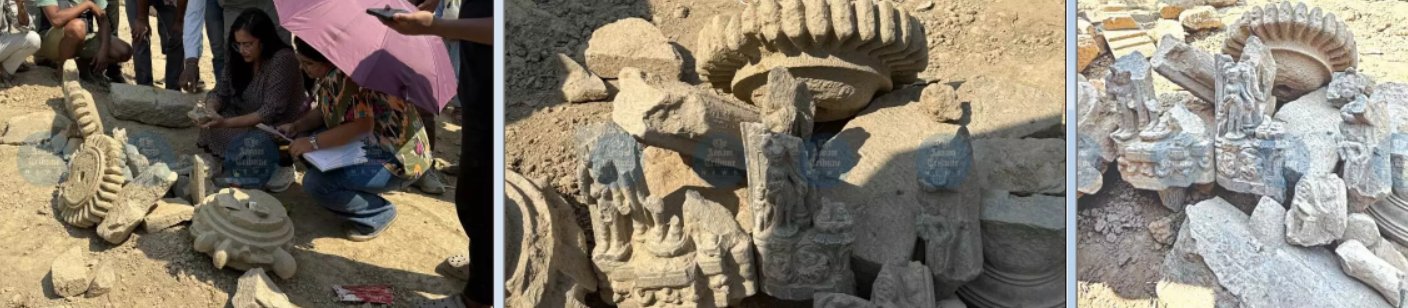
Image Source: assamtribune.com
The remnants of 10th-12th century have been unearthed at Harlongkuruati
village of Borgaon near Kampur of Nagaon district in a paddy field where
work was on in digging works for a mud dam construction along the
Kopili River. A stone temple plinth was discovered. The exposed
temple relics are part of an adhisthana and jangha portion of a stone
temple. Broken images of deities were also exposed, and a linear
arrangement of stone slabs was also observed.
The protected monument of the Bundura archaeological site lies approximately 1 km east of this newly reported site
Source: Archeological breakthrough: 10th-12th century temple
relics discovered in Nagaon by Rituraj Borthakur, assamtribune.com, 26
Mar 2025
* 2 Jan 2026
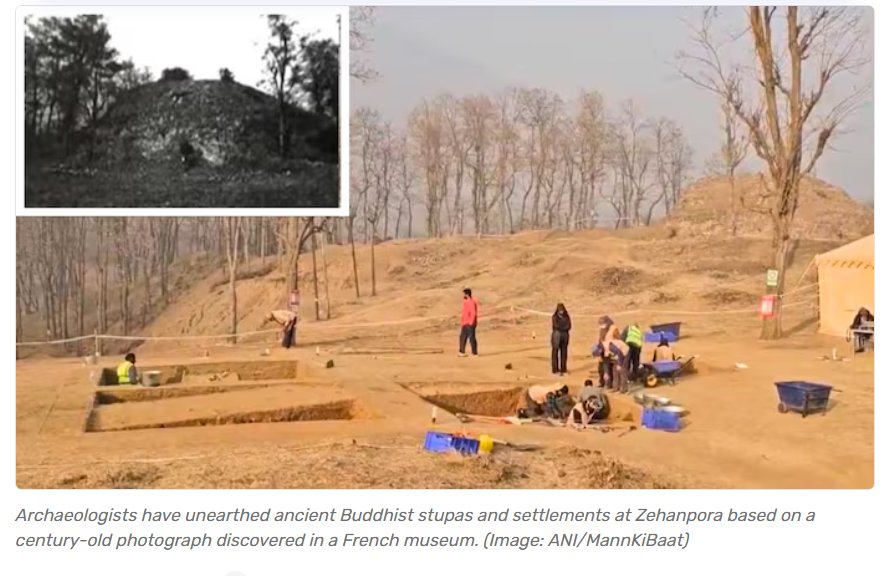
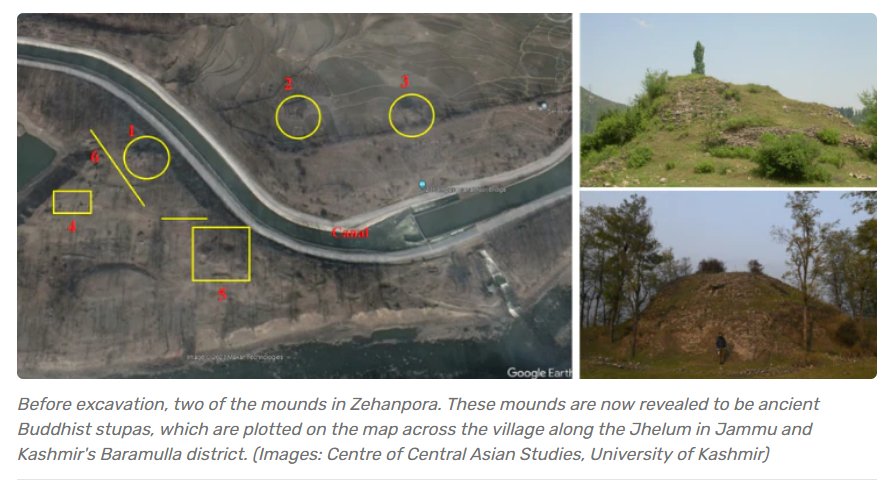
Images source: indiatoday.in
After decades of curiosity and surveys, the mounds in Baramulla's Zehanpora have revealed ancient Buddhist stupas and urban-type settlements, which link Kashmir to the Gandhara Buddhist network.
The discovery, made possible by old photographs at a French museum,
opened a 2,000-year-old chapter with Kashmir as a central hub of
Buddhist learning and monastic activity.
Zehanpora has yielded Buddhist stupas, an urban settlement complex(could
be chaityas and viharas), Kushan-era pottery shards, copper artefacts
and walls, with more finds expected in subsequent excavation phases. The
Zehanpora discovery places Kashmir within the 2,000-year-old Gandhara
Buddhist network.
Source: How blurry photos in France helped dig up Kashmir's 2000-year-old Buddhist past by Sushim Mukul, indiatoday.in, 29 Dec 2025
* 2 Jan 2026
The 2024-25 excavation season at Lothal, conducted by the
Archaeological Survey of India, marks the resumption of systematic
archaeological work at this major Harappan port with the help of modern
technology. The excavations revealed a rich ceramic assemblage and
numerous artefacts, including beads, terracotta figurines, seals, and
tools. One of the most promising and prominent field work in 2025, the
Lothal Excavations lays open unknowns and rekindles the known joys of a
Harappan site through the discoveries.
Source: Archaeological Survey of India, fb-IndianHeritage.GoI
* 4 Aug 2022
Lothal was a port city contemporary with Harappa and
Mohenjo-daro. The site was discovered in 1954 and excavated on most
scientific lines between 1955 and 1962. Lothal is situated at the head
of the Gulf of Cambay at a distance of 80 kilometres south-west of
Ahmedabad.
A fact of particular pride to chess lovers is that Dr S.R. Rao discovered some "chaturanga" pieces during excavations at Lothal. With carbon tests they are dated 2,500 B.C.
This proves that "chaturanga" was in vogue in India some 4,500 years ago.
Source: Views of V.D. Pandit (Bombay, India) from The Origins of Chess by Edward Winter, chesshistory.com
|