Snippets of Information
Rock art
* 2 Jan 2026
Rock art, in the form of paintings and engravings, is a clear
and lasting evidence of the transmission of human thoughts and beliefs
through art and graphic representations. It functions as a repository of
memory, enabling each culture to speak about themselves and their
origins in all geographical settings.
Source: whc.unesco.org
* 2 Jan 2026
Dr. V.S. Wakankar (the Pitamaha of Rock Art in India) is credited with exploring more than 4000 prehistoric rock art sites in India and abroad, but his most remarkable contribution being the explorations at iconic Bhimbetka Rock Shelters
in Madhya Pradesh in 1957. Bhimbetka is one of the largest rock art
sites in the world and is inscribed in the World Heritage List of UNESCO
in 2003.
Dr. Wakankar was also associated with excavations at Maheshwar (1954),
Navada Toli (1955), Kayatha (1966), Mandsaur (1974, 1976) and many other
significant sites which strengthened our understanding of chalcolithic
cultures popularly known as Kayatha and Malwa Cultures.
Being a multifaceted scholar, Wakankar also contributed immensely as a numismatist and epigraphist by collecting and deciphering thousands of early coins and inscriptions belonging to the ancient Indian history.
Source: Archaeological Survey of India, fb-IndianHeritage.GoI
* 2 Jan 2026
I do not believe these paintings were drawn either to decorate to caves
or to find entertainment. They were created as a means of escape from
suffering and as devotion to supernatural entity. Most of them are not
planned or organized nicely. Some have not taken the trouble to erase
older paintings before drawing the new ones on them. In a few spots, I
found four or five layers of sketches on top of another. The colors and
the styles of such layers, however, are different and have enabled the
experts to separate one from another. There are red, green, and white
colors in all hues and varieties. The same pigments were used to
decorate the dead and it is common to find these colors in funeral spots
also. The paintings were done primarily with a finger, but I believe
that they must have used feathers, wooden sticks, and needles of
porcupines for different styles and textures.
Source: Prehistoric Rock Paintings of Bhimbetka by Dr. K. L. Kamat, First Online: 15 Aug, 1997, Page Last Updated: 15 Dec 2025
* 2 Jan 2026
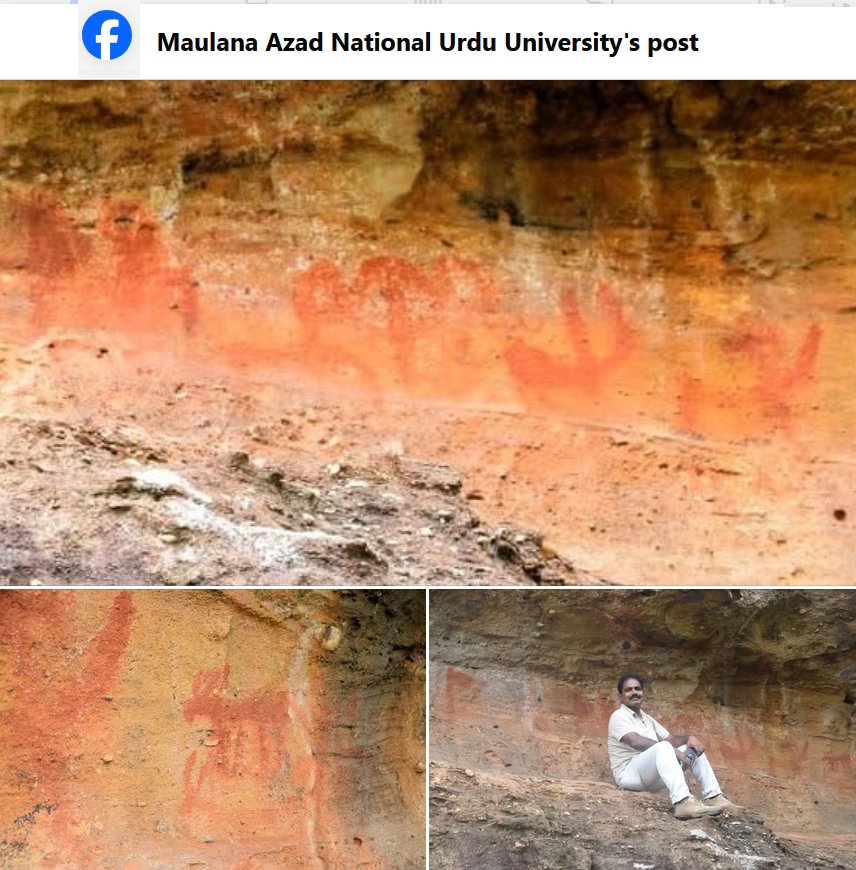
Image Source: Maulana Azad National Urdu University, fb-manuuhydofficial
Prehistoric Site Unearthed in Bhadradri Kothagudem District by MANUU Scholar
Shanagandrev Rock Art - A Glimpse into the Ancient Mind
A newly discovered rock art site of significant prehistoric value has come to light near Palwancha, in Bhadradri Kothagudem district of Telangana.
This site is located near Aksaraloddi, between Jagannadhapuram and
Annapureddypalli in Mulkalkapalli Mandal, approximately 2 kilometers
from Nallamudi village, nestled within dense forest terrain. The
coordinates of the site are Latitude 17.401043 N and Longitude 80.815642
E, at an elevation of around 240 meters above sea level.
This important discovery was made during an exploration by historical researcher Kondaveeti Gopi,
who has earlier brought to light several megalithic and prehistoric
sites in the region. Notably, he had previously discovered the Ontigundu Rock Art site near Nallamudi village and submitted a research paper on it to the Rock Art Society of India (RASI).
In the current exploration, Shiva, a local youth from Nallamudi,
actively participated alongside Kondaveeti Gopi in identifying this
site. The newly discovered rock art includes depictions in red ochre of
animals, hunting scenes, and human figures, rendered on the natural rock
surfaces. These symbolic images are believed to have been created to
convey beliefs, rituals, or messages by early human communities to
future generations.
Based on the stylistic and thematic elements, these paintings are
tentatively dated to the Mesolithic period (approximately 10,000-5,000
BCE) or possibly to the early Neolithic transitional phase. The use of
natural red pigment and themes of hunting and animals are typical of the
Mesolithic hunter-gatherer culture.
In addition to the rock paintings, wood fossils have also been
identified in the same area, indicating the region’s rich ecological and
prehistoric past.
Kondaveeti Gopi, who is currently a research scholar pursuing Ph.D at
H.K.Sherwani Centre for Deccan Studies, Maulana Azad National Urdu
University (MANUU), has a long-standing history of documenting and
discovering Megalithic and prehistoric sites across Telangana,
particularly in tribal and forested regions.
This new discovery at Shanagandrev not only adds another chapter to the
prehistoric record of Southern India but also stands as a milestone in
the exploration of Mesolithic cultural heritage in the Eastern Godavari
Basin region.
Source: (Dr. Mohd. Mustafa Ali), Public Relations Officer I/c. , Maulana Azad National Urdu University, fb-manuuhydofficial
|