SNIPPETS OF INFORMATION
LOCATIONS IN ANDHRA PRADESH
* 4 May 2026
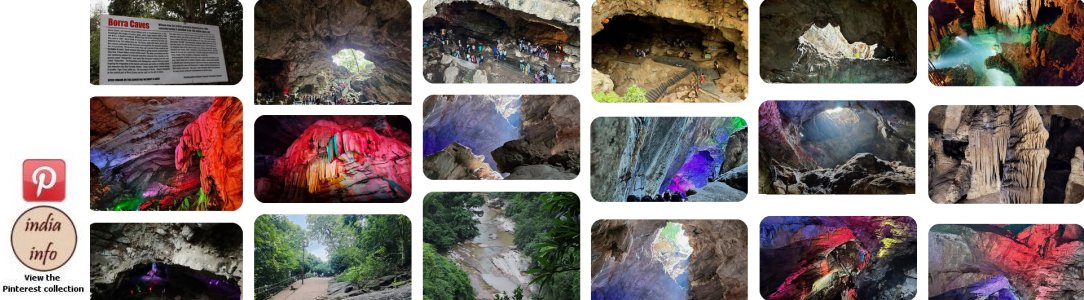
Situated at an elevation of about 705 meters above sea level, the Borra Caves
(Borrā Guhalu, where 'Borra' means abdomen and 'Guhalu' means 'caves'
in Telugu) are located in the Ananthagiri hills in Araku Valley, Alluri
Sitharama Raju district, Andhra Pradesh. The Borra Caves are among the
largest caves in India reaching depths of up to 80 m, discovered in 1807 by William King George of the
Geological Survey of India. The caves are renowned for their impressive
stalactite and stalagmite formations, created by the perennial flow of
the Gosthani River. The caves were formed due to the dissolution of
limestone by acidic water over millions of years. There are an array of
speleothems (mineral deposits that form in caves over time), including
stalactites and stalagmites of various sizes and shapes.
The formations continue to transform. The reason was the same that
resulted in the formation of these caves over a long period: the
reaction between calcium carbonate and limestone dissolves the minerals
in the stone, leading to its disintegration. As small streams from the
hills flow into the Gosthani River below, the reaction erodes the
stones. Further, water seeping from the cave roof reacts with calcium
bicarbonate and other minerals on the rocks, creating mound-like
stalagmites on the ground and spear-like stalactites hanging from the
ceiling.
Sources: borracaves.in ; incredibleindia.gov.in
The cave formations are natural with unique features for the growth and
development of various species of flora and fauna. Further they provide
shelter for many biological organisms. In recent years the scenario
was changed due to installation of artificial illumination to attract
tourists and this has altered the physico-chemical features of the caves.
Species of algae to pteridophytes and lichens were observed in different
regions of the Borra caves. Near the entrance of the cave five
species of Bryophytes, four species of Pteridophytes, one species of
Crustose Lichen and 10 species of algae were recorded. 12 species of
Lampen flora were identified in dark zone of the cave where it is
illuminated by artificial light during the day time. They appear as blue
green, dark brown or black patches on the surfaces of rocks near the
illuminated regions. Among the Lampen flora, Cyanophyceae species were
more dominant than the members of the Chlorophyceae and only one species
of Bacillariophyceae was recorded in this study.
Source: researchgate.net
|